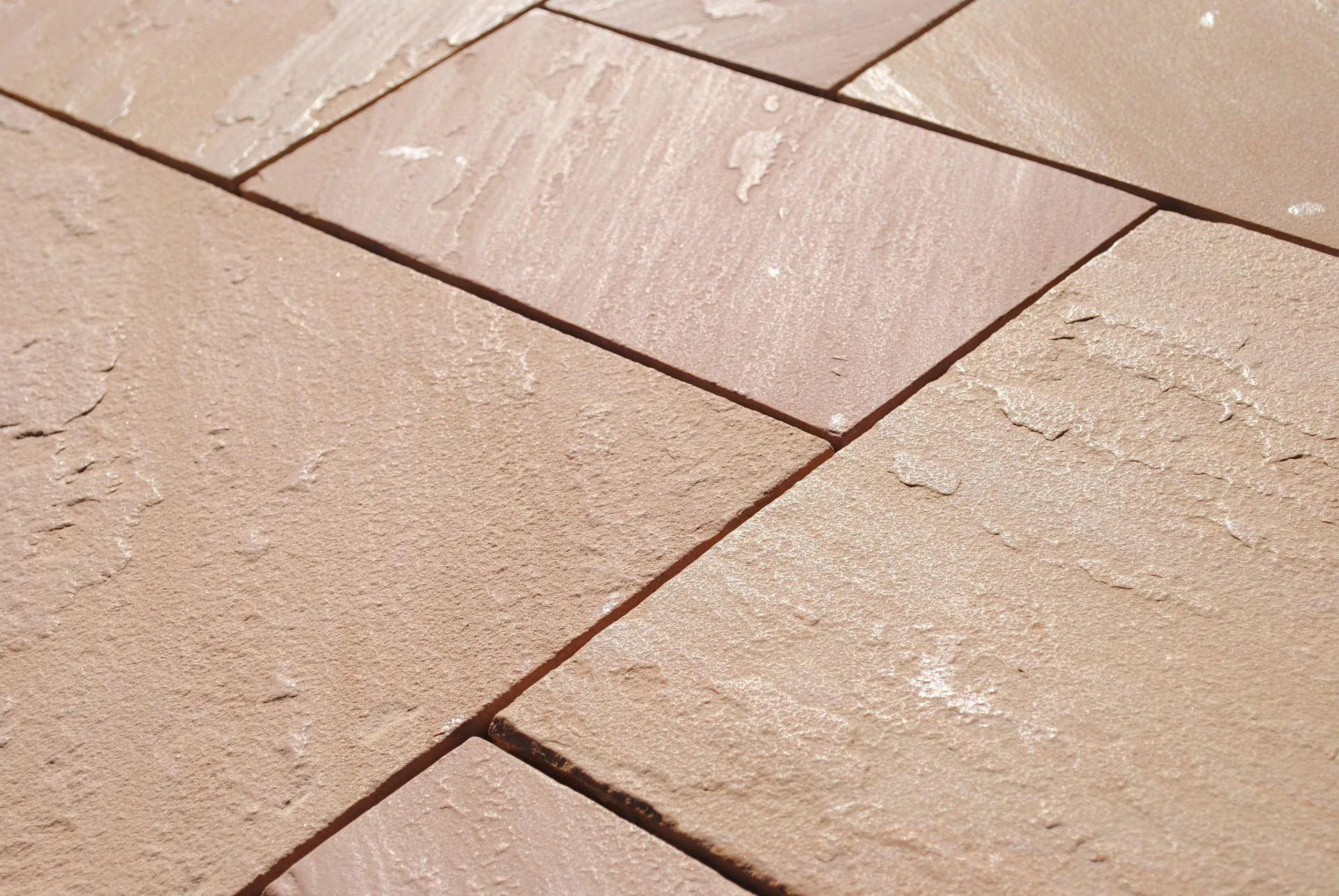
Paving size, thickness and finish decide whether a UAE pool deck or terrace stays cool underfoot and safe when wet - a practical guide to specifying natural stone paving that performs, not just photographs well. A paving slab and a cobblestone sett are not interchangeable, even though both get lumped together as "stone paving" in a quick supplier conversation - and getting that distinction right is usually what separates a pool deck or terrace that reads calm and considered from one that ends up too hot, too slippery, or fighting the pattern of the house behind it.
Slabs and setts are different products
Our Landscape and Outdoor range covers both, and they are specified for different jobs. Paving slabs are flat-sawn and supplied from 10 x 10 cm up to 60 x 60 cm, at 40-100 mm thickness - a larger, thinner format built for open ground-plane surfaces: pool surrounds, terraces, courtyards. Cobblestone setts run smaller, from 100 x 100 mm to 200 x 200 mm, thicker at 30-60 mm, and are built to take the twisting load of a turning car tyre - we go through that specification separately in choosing cobblestone for a UAE driveway. A deck or terrace with no vehicle loading rarely needs a cobble's strength, and slabs give a calmer, more contemporary surface with fewer joints to collect grit and pool splash.
Size decides how the surface reads
A 60 x 60 cm slab, laid with tight joints, reads as a broad, unbroken plane - the choice for a large terrace or a deck where the aim is a calm, continuous surface running to the water's edge. Smaller formats - 10 x 10, 10 x 20, 30 x 30 cm - suit borders, step treads, coping details and tighter courtyards, where a bigger slab would look oversized or need awkward cutting around the pool's edge. Mixing scales deliberately - a large field with a smaller-format border - is a common way to frame the water without changing material.
Finish decides whether it is safe wet
This is the detail most often skipped, and the one that matters most beside water. A honed finish is smooth and clean-looking but gets genuinely slippery once wet, which makes it a poor choice for the actual coping and immediate pool surround, whatever it looks like dry in a sample box. Shotblast and tumbled finishes give real texture and grip underfoot without reading as rough, and sawn slabs sit between the two - textured enough for safe footing, tidier than a fully tumbled surface. We go through how each finish behaves more generally in six stone finishes, explained; around a pool, treat grip as the deciding factor before how a finish looks in a photograph.
Colour and heat underfoot
Surface temperature is a real specification question on an unshaded UAE deck, not a detail to leave until the stone is already down - as we cover in choosing stone for the Gulf climate, darker stone absorbs more heat and light stone reflects more of it. A pale sandstone or ivory limestone stays markedly cooler under bare feet through the afternoon than a dark, deep-toned stone laid in full sun, which is why lighter tones are the usual default for pool surrounds and unshaded courtyards, with darker stone reserved for shaded areas or used as a contrasting border rather than the full field.
Sandstone or limestone
Both are supplied for paving, and the choice follows the same logic as sandstone versus limestone for cladding. Sandstone's coarser grain gives more natural texture and grip, and a warmer, more organic tone that suits villas and traditional landscaping. Limestone's finer, more even grain reads cleaner and cooler, better suited to a minimalist terrace where colour consistency across a large area matters more than texture. Neither is the wrong answer generally - it depends on the rest of the elevation the deck sits against.
Before you order
Every paving order is cut to your project rather than picked from a fixed module, the same made-to-order approach that runs through our catalogue. Bring us the deck or terrace plan with the pool edge marked, how much of it sits in direct sun, and the stone already used on the house or boundary wall, and we will recommend a size, finish and material - and tell you plainly if a finish you like the look of is not the one to put next to water.
Ready to talk about your project?
Share your drawings or a reference photo and we'll come back with material options and an honest estimate.