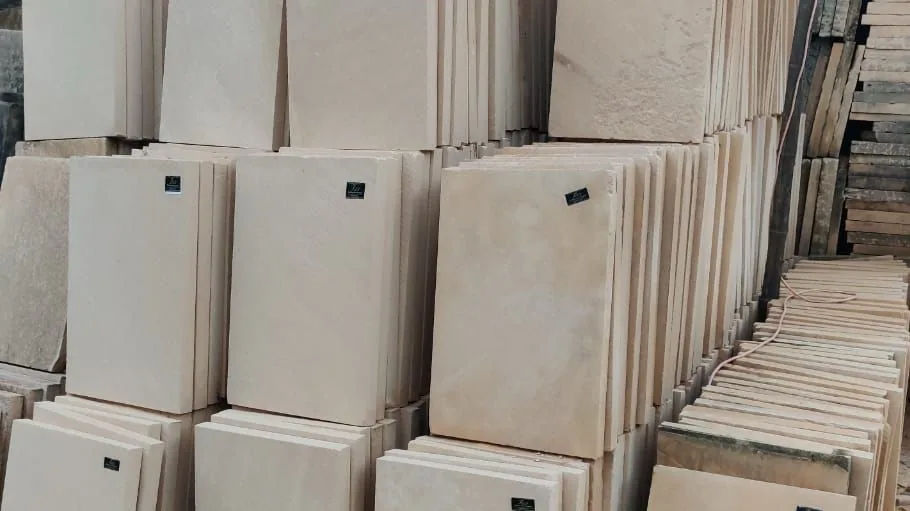
Sandstone or limestone for your cladding project? A practical comparison of look, texture, performance and specification for UAE villas and commercial facades. These are the two materials we're asked to compare more than any other for cladding projects, and it's easy to see why: photographed under similar lighting, a beige sandstone and a pale limestone can look almost interchangeable. On a wall, in this climate, they behave differently enough that the choice is worth making deliberately rather than on looks alone.
How they're actually different
Sandstone forms from compacted sand grains - quartz, feldspar and other minerals - cemented together over time, which gives it a naturally granular texture and a warm, earthy colour range: beige, gold, brown, rust. Limestone forms from compressed marine sediment, largely calcium carbonate, and tends to have a finer, more uniform grain with a cooler, more even colour range: ivory, cream, grey. That difference in formation is the root of almost everything else that separates them.
Look and texture
Sandstone typically has more visible grain and colour variation piece to piece, which gives cladding a warmer, more organic, slightly rustic character - it suits traditional and transitional architecture particularly well. Limestone's finer, more consistent grain gives a cleaner, more uniform surface that suits contemporary and minimalist facades, where visual consistency across large panel runs matters more.
Performance on a UAE exterior
Both can perform well outdoors here, but the details matter - see our fuller breakdown in choosing stone for the Gulf climate. Sandstone, in the right density, handles heat cycling and salt exposure well and is what most of the region's traditional architecture was built from. Limestone is generally denser and can be more weather-resistant, but this varies more by specific grade than sandstone does - a soft, porous limestone is a poor exterior choice, while a dense one performs excellently. This is exactly the kind of detail to confirm with whoever is supplying it, not assume from the name alone.
Working with the material
Sandstone's granular structure takes carved relief and bush-hammered texture particularly well - it's why most of our sculptural feature walls are carved in sandstone. Limestone's finer grain suits crisp, clean-edged cladding profiles and honed or polished surfaces where a smoother, more refined result is the goal. Neither is "better" for carving in general - it depends on the depth and character of the design.
Cost and lead time
Pricing for both depends far more on the specific quarry, grade, thickness, finish and quantity than on sandstone versus limestone as categories - there's real overlap, and either can end up costing more depending on those specifics. The same is largely true of lead time. Treat "which is cheaper" as a question for your actual quotation rather than a general rule.
Which to specify
Choose sandstone for a warmer, more textured, traditional or transitional look, and for deep carved relief work. Choose limestone for a cleaner, cooler, more contemporary facade with consistent colour across large areas, confirming the grade suits exterior use. If you're unsure, send us your elevation drawings or reference photos and we'll recommend a material with reasons, not just a preference.
Ready to talk about your project?
Share your drawings or a reference photo and we'll come back with material options and an honest estimate.