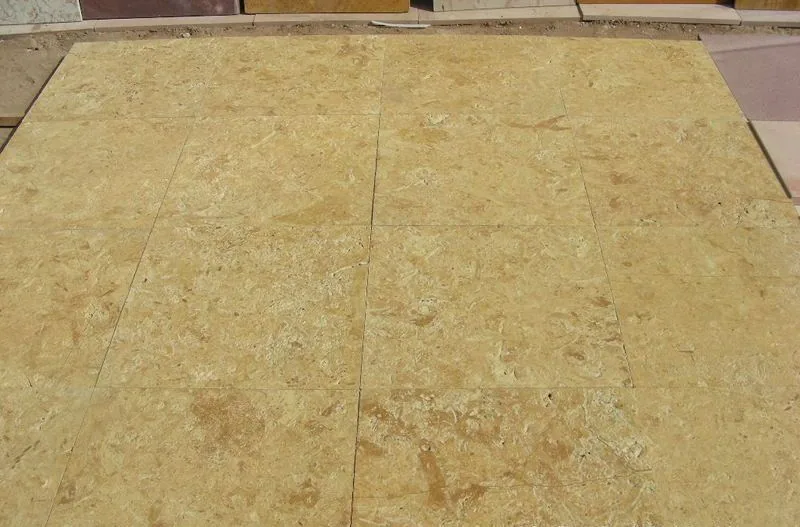
A practical guide to the six most common natural stone finishes - honed, polished, bush-hammered, sandblasted, split-face and antique - and when to specify each for UAE projects. The same design, in the same stone, can look almost unrecognisable depending on the finish applied to it: finish isn't a cosmetic afterthought, it changes how light behaves on the surface, how visible tool marks and carving detail are, how the stone ages, and in exterior applications, how well it copes with heat and salt air. It's also one of the last stages in how a carved wall is actually made, but it changes the result as much as any earlier step.
Honed
A smooth, flat, low-sheen surface with no gloss - matte rather than mirror. Honed finishes hide fingerprints, minor scratches and surface change far better than polished stone, which is why it's the most common choice for UAE exteriors and heavily used interior floors. It reads as understated rather than showy, and pairs well with almost any carved or cladding design.
Polished
A high-gloss, reflective surface achieved by grinding the stone progressively smoother. Polished stone shows colour and veining at their most saturated, which is why it's popular for interior feature walls and furniture pieces where you want the material itself to be the visual statement. It shows scratches, etching and surface change more readily than other finishes, which is part of why we steer it away from harsh exterior exposure.
Bush-Hammered
A deliberately textured, slightly pitted surface created by repeatedly striking the stone with a bush hammer - a tool with a grid of pyramidal points. It gives a rugged, tactile, matte finish that reads as solid and grounded rather than refined. On a carved relief, a bush-hammered finish adds texture to texture, deepening the shadow play across the design. Common on exterior cladding and landscape work.
Sandblasted
Fine abrasive is blasted at high pressure across the surface, producing a soft, slightly grainy matte texture, gentler than bush-hammering. It's a good middle ground between honed smoothness and a more rugged texture, and it works well for carved pieces where you want texture without heavy shadow. It's also commonly used to selectively age or contrast specific areas of a design.
Split-Face
Rather than being ground or tooled, split-face stone is fractured along its natural cleavage, leaving an irregular, deeply textured surface that follows the stone's own grain. It's the least "finished" looking finish by design - each piece is genuinely unique - and it's most often specified for feature cladding and landscape walling where a raw, quarried character is the point.
Antique
A tumbled or artificially aged surface that softens edges and gives new stone the worn, settled look of material that's been in place for decades. It's specified deliberately for projects going for a heritage or old-world character - traditional courtyards, restoration-style interiors - rather than a contemporary look.
Choosing between them
There's no universally "best" finish - it depends on the design, the location, and the character you're going for. As a rough starting point: honed or bush-hammered for most UAE exteriors, polished or antique for interior statement pieces, split-face or sandblasted for landscape and raw-textured cladding. We can carve and finish sample pieces so you can see and feel the actual difference before committing to a full wall.
Ready to talk about your project?
Share your drawings or a reference photo and we'll come back with material options and an honest estimate.