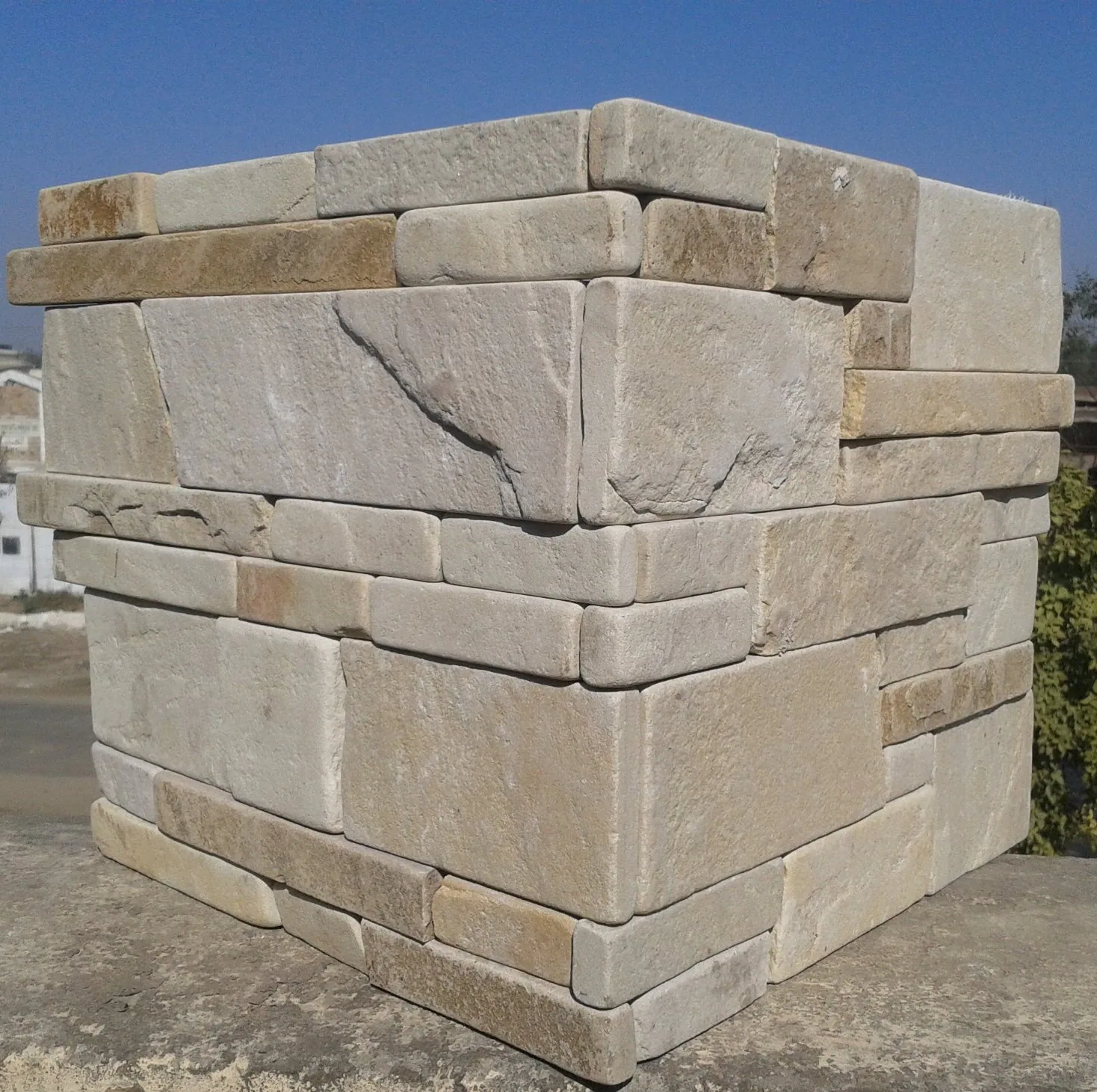
Five stone cladding patterns explained - crazy cladding, ledge stone, flagstone, brick stone and stack stone - and how to choose the right one for your facade. Walk into most conversations about cladding and the discussion jumps straight to material - sandstone or limestone, this tone or that one - before anyone asks the more basic question: what pattern is the stone actually cut and laid in? The pattern changes the texture, the shadow line and the joint width as much as the material itself does.
Here is what separates the five cladding patterns we cut most often, and a way to think about which one suits a given wall.
Crazy cladding - the irregular, dry-stone look
Crazy cladding is hand-fitted from irregular broken stone pieces, each panel its own jigsaw of shapes with no repeating grid. It reads as a natural dry-stone wall while installing as a flat panel system, cut to 15-25 mm thickness with a natural split face. It is the pattern to reach for when the brief is rustic or organic - boundary walls, garden walls and feature walls where a busy, unrepeating texture is the point rather than something to avoid.
Ledge stone - long courses, deep shadow
Ledge stone is cut and fitted in long horizontal courses that stack with a pronounced natural face, throwing genuinely deep shadow lines across the elevation once the sun catches it at an angle. It comes in beige, black, off-white and mixed tones, at 20-40 mm thickness, with a natural, shotblast or bush-hammered finish. This is the pattern that photographs best under raking evening light - a strong choice for entrance walls, fireplace surrounds and any facade that gets direct low sun for part of the day.
Flagstone - flat and tightly fitted
Flagstone panels combine flat, naturally faced stone pieces fitted tight with fine joints - flatter and more contained than crazy cladding, with far less depth variation. Cut in sandstone or basalt at 20-30 mm, with honed, chiselled, tumbled or natural-rock finishes, it works equally well on a wall or as flooring, which makes it a practical choice where a wall surface needs to visually continue onto the ground plane, such as a pool deck running into a boundary wall.
Brick stone - texture with a predictable grid
Brick stone cladding is cut to consistent brick-format sizes - 28 x 56 cm, 20 x 40 cm or 15 x 40 cm - and laid in a regular coursed pattern, giving the texture of natural stone with the visual order of brickwork. It comes in a wide colour range, from Modak and Cuddapah tones through to Chocolate and Basalt, with honed, natural-rockface or chiselled finishes. Where a client wants natural stone's texture but a tidier, more architectural elevation than crazy or ledge cladding gives, brick stone is usually the answer.
Stack stone - fine, linear, tailored
Stack stone is cut into narrow linear strips and set in tight horizontal courses - a finer, more uniform cousin of ledge stone, closer to a tailored surface than a rustic one. It spans a wide colour range, from black slate through sandstone to white marble and copper quartzite, at 20-30 mm thickness. It suits interior feature walls and reception walls where the brief calls for texture without losing a sense of precision.
Matching a pattern to the project
Three questions usually settle it. First, how much sun does the wall get, and from what direction - ledge and stack stone earn their keep under raking light, while flagstone and brick stone read consistently well even in flat, shaded conditions. Second, is the finish meant to feel rustic or tailored - crazy cladding and ledge stone sit at the rustic end, brick and stack stone at the tailored end, with flagstone in between. Third, does the surface need to survive UAE exterior conditions - we have written separately about choosing stone for the Gulf climate and about sandstone versus limestone for cladding, and the same logic applies to pattern: a busier, deeper-jointed surface collects more dust and needs more regular washing on an exterior facade than a tight-jointed one.
None of these five patterns is objectively better than another - they are different tools for different walls. We cut and fit all five from our own workshops, in the material and finish that suits your project, and can send samples of each pattern before anything is cut. Browse the full catalogue or get in touch with your wall dimensions, and we will suggest a pattern to start from.
Ready to talk about your project?
Share your drawings or a reference photo and we'll come back with material options and an honest estimate.