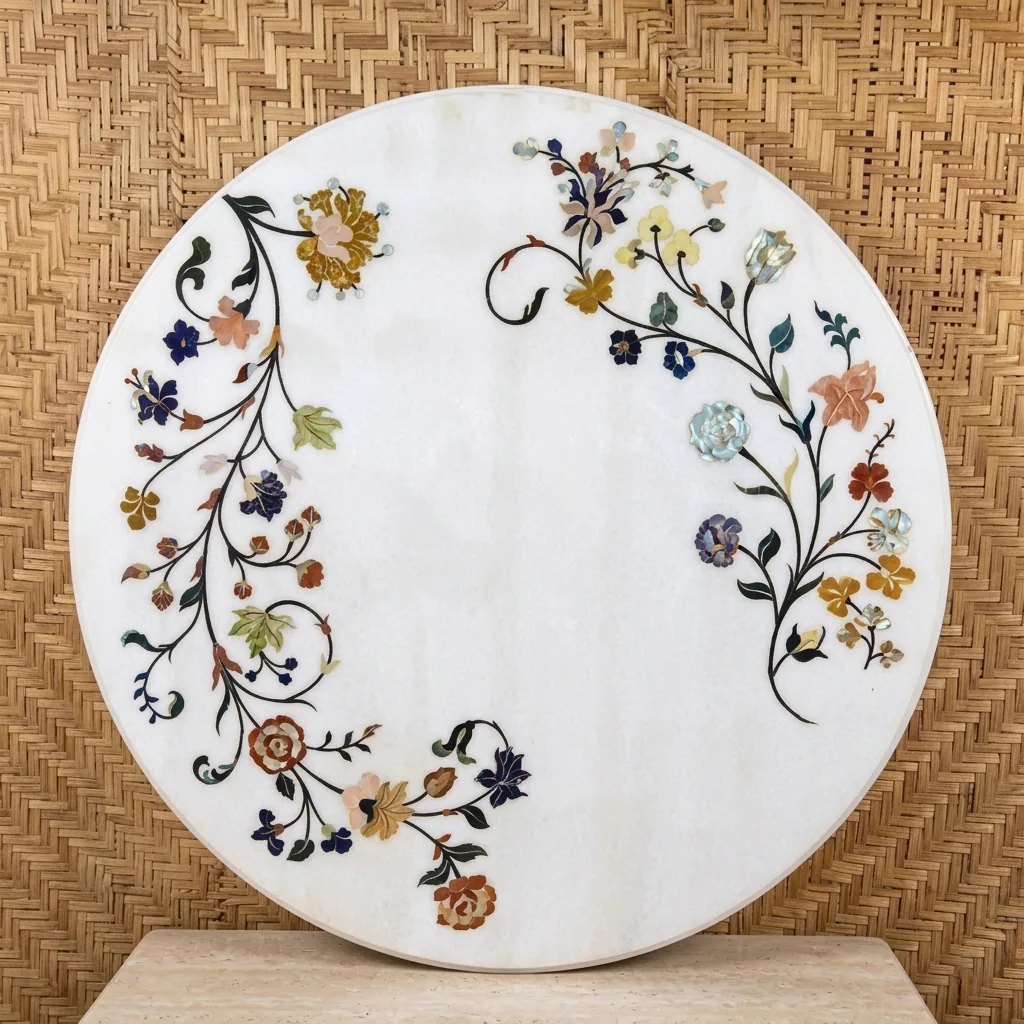
A practical guide to stone inlay flooring - medallions, mosaic, borders, patterned floors and water-jet cutting - and where each actually earns its place in a UAE home or lobby floor. Inlay is easy to mistake for a printed or applied pattern, but it isn't: every line and colour change is a separate piece of stone, cut individually and fitted so the joints disappear into the design. That's what separates it from tile-printed imitations, and it's also why choosing the right type of inlay for the right part of a room matters more than it looks like it should.
Medallion: the floor's one centrepiece
A medallion is cut piece by piece from selected marble and stone, then fitted so the pattern reads as one continuous motif rather than a collection of tiles. It's designed to be the single focal point of a floor - beneath a dining table, in a foyer, under a dome - and it works best set into an otherwise plain field, where nothing else competes with it for attention. A medallion in a room already busy with pattern or heavy furniture usually gets buried rather than showcased.
Border and banding: detail without commitment
A border runs a contrasting stone line around the edge of a floor field, or along the transition between two rooms. It's the most restrained form of inlay we do, and often the most practical: it adds a clear sense of intention without the cost or visual weight of covering the whole surface, and it pairs naturally with a central medallion if you want both.
Mosaic: pattern at close range
Mosaic inlay sets small, individually cut pieces of stone by hand into geometric or floral fields - a slower, more labour-intensive technique than a medallion or border, since the piece count per square metre is far higher. It rewards being seen up close, which is why it tends to work best on feature floors and wall panels in spaces people spend time in rather than pass through - a powder room, a spa floor, a small courtyard - rather than a corridor glanced at in passing.
Patterned floor inlay: covering the whole room
Rather than sitting as an isolated feature, patterned floor inlay repeats a geometric design across a full floor area, built from multiple stone colours cut to interlock precisely. It suits foyers, courtyards and formal reception floors where the floor is meant to read as a considered surface throughout, not just at one point. It's a bigger commitment than a medallion or border - more stone, more cutting, more fitting time - so it's worth confirming the design at full scale before cutting starts, not just in a small sample.
Water-jet cutting: how the fine detail actually happens
Water-jet cutting is what makes the curves and fine detail in a complex medallion or pictorial panel possible, while keeping true stone-on-stone inlay rather than a printed surface. A blade or hand tool can cut a straight border cleanly, but it can't follow a tight curve or a fine pictorial outline the way a water jet can - which is why the most detailed medallions and pictorial floor panels in our Inlay collection rely on it specifically, not as a marketing term but as the actual cutting method.
Custom slabs: designed against your drawing, not a catalogue
Not every inlay project is a floor. Custom inlay slabs and panels - table tops, wall panels, feature slabs - are designed and cut against your drawing rather than picked from a fixed list, the same made-to-order approach that runs through the rest of our catalogue. If you have a specific size, motif or stone combination that doesn't match any category above, this is usually where it belongs.
Material and finish decide how it wears, not just how it looks
Inlay work is supplied in marble, sandstone or limestone, generally finished polished or honed. Marble gives the sharpest colour contrast and the most dramatic veining, which is why most medallions and mosaic work use it - but it's also the most porous of the three and needs sealing, particularly in a polished finish underfoot, a consideration we go through more generally in choosing stone for the Gulf climate. A honed finish - covered alongside the rest in six stone finishes, explained - hides scuffing and foot traffic better over time, at some cost to the contrast a polished surface gives a medallion or border.
Getting the scale right before anything is cut
The single most common mistake with inlay isn't the pattern or the material - it's scale. A medallion sized to look right in a catalogue photograph can read as undersized or oversized once actually set into your specific foyer or dining area, and a pattern that looks clear on paper can turn busy or illegible at full floor size. We build a scaled render against your actual room dimensions before cutting starts, the same approval step we'd use for any bespoke carved piece - the cheapest place to catch a sizing problem, and the last one where fixing it costs nothing.
If you're weighing a medallion against a border, or wondering whether a pattern will actually suit your floor at full size, send us your room dimensions or drawing and we'll tell you honestly what would work - and what wouldn't.
Ready to talk about your project?
Share your drawings or a reference photo and we'll come back with material options and an honest estimate.