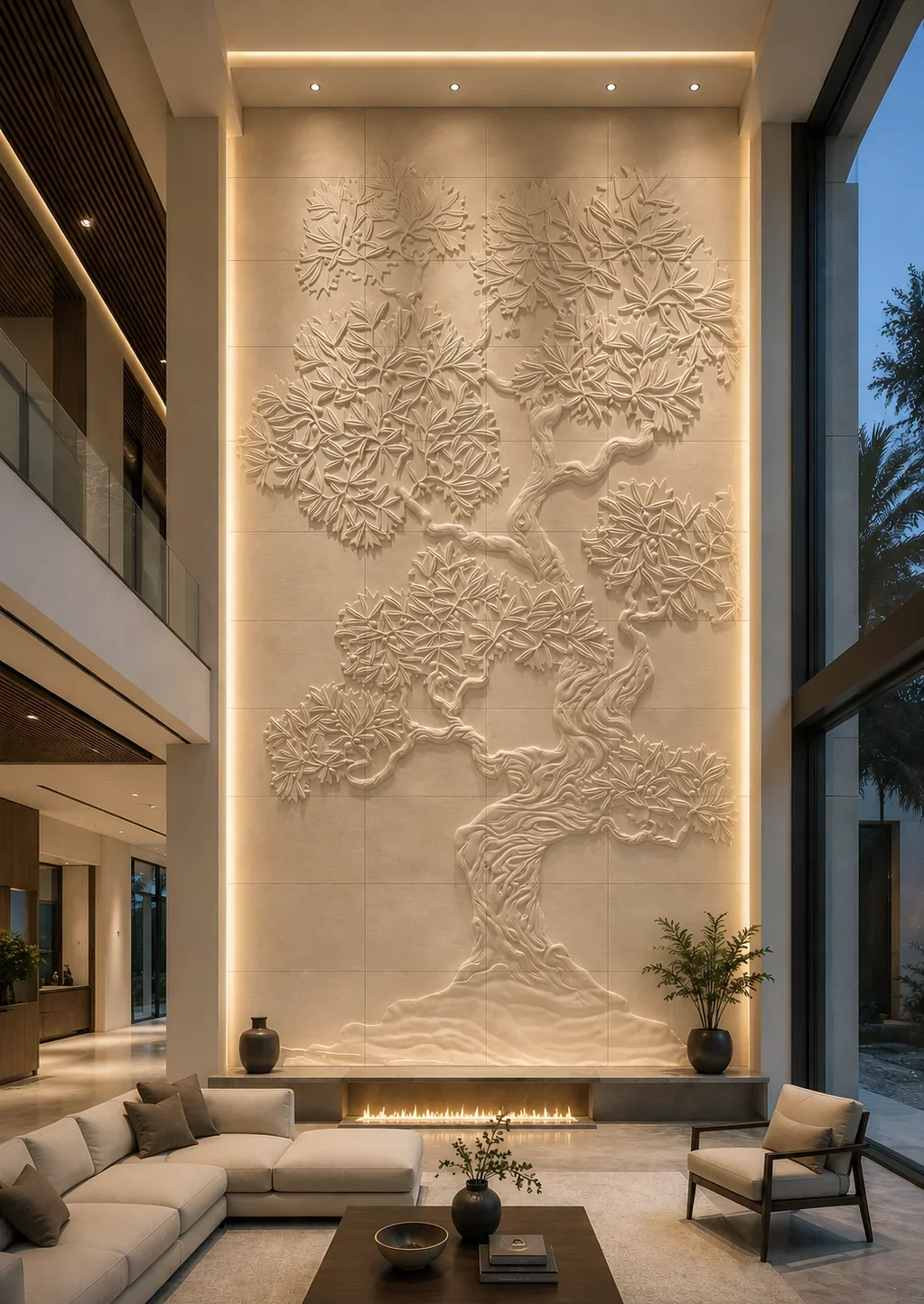
What actually happens between commissioning a carved stone feature wall and having it installed - design, material selection, carving and fitting, stage by stage. "Carved feature wall" covers a lot of very different amounts of work, and most of it happens long before anyone picks up a chisel: here's what the process actually looks like, from a client's first message to a finished wall on site.
1. It starts with your space, not our catalogue
Every commission begins with understanding the wall itself - its dimensions, the light it gets, what's around it, and what you're trying to achieve. A catalogue design is a starting point, not a fixed product; almost everything we make gets adjusted to fit the actual space rather than the other way round. This is also where we tell you honestly if something won't work - a heavily textured relief in a dim corridor, for instance, rarely reads the way people expect.
2. Material and finish get chosen deliberately, not decoratively
The stone and finish aren't picked purely on appearance. Whether the wall is interior or exterior, shaded or in direct sun, coastal or inland all affect which stone makes sense - we've written about this in more detail in choosing stone for the Gulf climate. This decision happens before design work goes further, because it can affect what's carveable and how deep a relief can safely go.
3. The design gets rendered before anything is cut
For any carved or bespoke piece, we build a 3D visualisation and revise it with you until it's right. This is the cheapest stage to make changes at - moving a wave, adjusting a depth, resizing a panel costs nothing here and costs real money and time once stone has been cut. We don't move to production until you've approved the render.
4. The stone is selected and cut to size
Blocks or slabs are chosen for consistency of colour and grain, then cut to the panel dimensions the design calls for. This is also where any quiet defects in the raw stone - a hidden fracture line, an inconsistency - get caught, before hours of carving time are invested in a piece that wouldn't have held up.
5. Roughing out the relief
The bulk of material removal happens first, blocking in the broad shape of the design - the difference between the deepest and shallowest points, the major forms. This stage is mechanically assisted; it sets up the piece for the work that actually defines it.
6. Hand-carving is where the piece becomes itself
This is the stage that separates a carved wall from a machined panel. An artisan works the surface by hand - the transitions between forms, the texture, the small irregularities that make a wave or a petal or a grain of wood look grown rather than manufactured. Two panels of the same design are never quite identical, because this stage isn't automated and we don't want it to be.
7. Finishing
Honed, sandblasted, bush-hammered, antique or polished - we cover each of these in six stone finishes, explained - the finish is applied last, and it changes how the carving reads as much as the carving itself does. A deeply carved relief in a bush-hammered finish looks and feels very different from the same carving polished smooth, even though the underlying form is identical.
8. Packing, shipping and installation
Finished panels are packed for transport from our workshops in India to site in the UAE, where our own installation teams fit them - sequencing panels correctly, aligning joints, and in the case of relief walls, coordinating with the lighting plan so the carving reads the way it was designed to.
How long this actually takes
For a carved feature wall, six to ten weeks is typical from approved design to installation, depending on size and carving depth - see our full lead time breakdown on the FAQs page. Sculptural or highly custom commissions can run eight to fourteen weeks. None of these stages can be meaningfully rushed without compromising the result - which is exactly why the render approval stage matters so much: it's where changes are still nearly free.
If you have a wall in mind, send us your drawings or a photo of the space and we'll walk you through what a design for it would actually involve.
Ready to talk about your project?
Share your drawings or a reference photo and we'll come back with material options and an honest estimate.