Carved relief and stone inlay both turn a plain wall into a feature, but they work in opposite ways - one uses depth and shadow, the other uses colour set flush into the stone. Knowing which one you are actually looking at, and how each behaves once it is on your wall, is the quickest way to narrow a long catalogue down to the two or three designs that suit your room.
Relief: pattern made from light
Most of the designs in our Bespoke Walls collection are carved relief. The pattern is cut into a single material - sandstone, marble or limestone - at varying depths, so what you see is not colour but shadow. Arabian Dunes carves long overlapping ridges in shallow relief; Arch And Axis grades its depth from a few millimetres at the horizon to far deeper at the foreground columns, which is what gives it real perspective. The stone itself is usually one tone. The design comes from how light falls across it.
That has a practical consequence: a relief wall changes through the day. Under flat overhead light it can read quiet, almost plain. Under grazing light from above or the side it becomes dramatic. Lighting is not an accessory to a relief wall - it is half the design, which is why we wrote a separate guide on lighting a relief wall.
Inlay: pattern made from colour
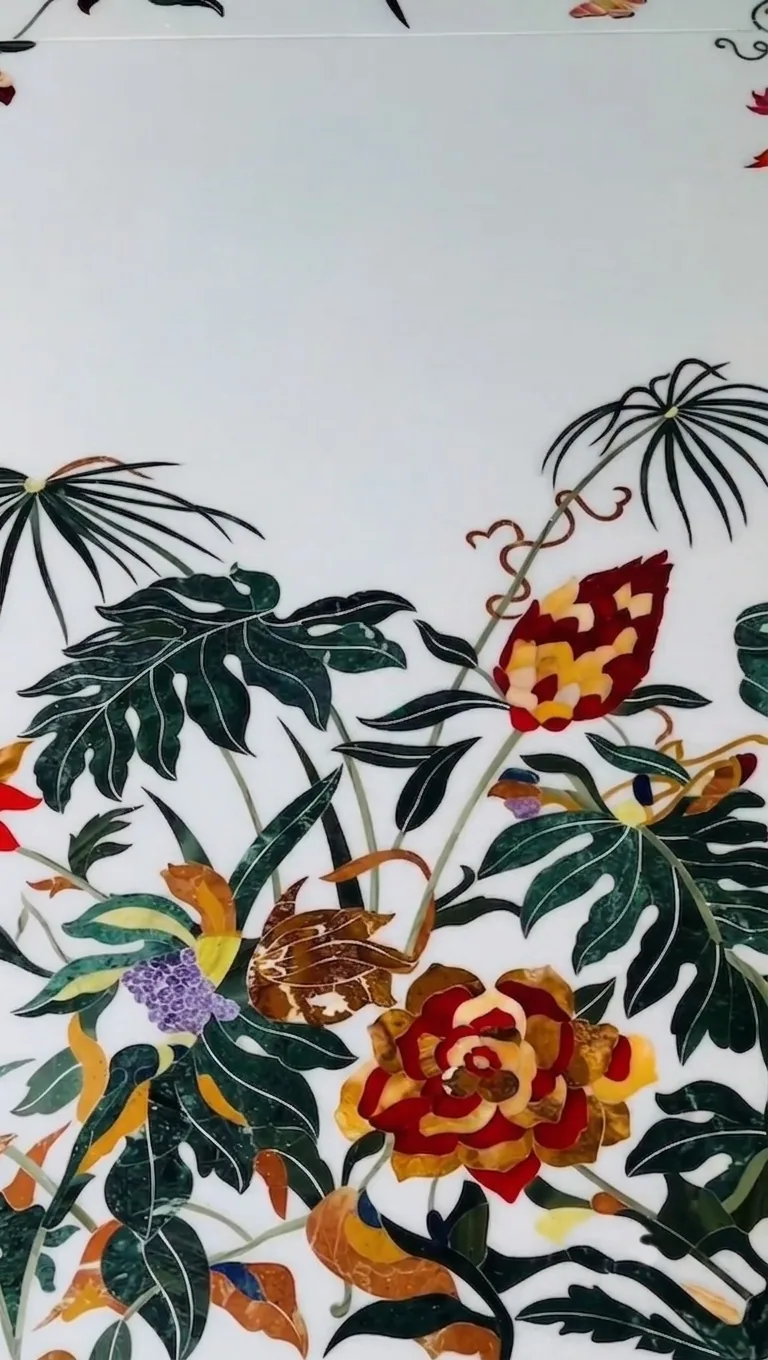
Inlay works the other way round. The motif is cut into a base slab and the recesses are filled with contrasting pieces of stone, fitted so the surface finishes flush. There is little or no depth to catch light - the pattern is carried entirely by the colour and veining of the stones used. Intarsia, for example, sets blossom and branch forms in contrasting marble and brass into a plain slab. Songbird Bloom goes further in the pietra dura tradition, with birds, leaves and blossoms cut from lapis lazuli, malachite, jasper and mother of pearl on a marble ground. Because the colour comes from the stone itself rather than from paint, it does not fade.
Mosaic sits close to inlay. Fern Mosaic is built from small hand-cut tesserae in golden, bronze and natural tones, each set individually, so no two panels come out identical. It is finished flush and polished, like inlay, and reads best at close range.
How the room decides
A few questions usually settle it:
- How far away is the viewer? Relief carries across a double-height lobby or a long majlis, because shadow reads at distance. Fine inlay and mosaic reward being seen from a metre or two - a powder room, a dining room wall, a headboard, a lift lobby.
- How much control do you have over lighting? If the wall will only ever get flat ceiling light, relief loses much of its effect. Inlay looks the same under almost any light, because it does not depend on shadow.
- Does the room want colour? Relief keeps a room calm and tonal. Inlay brings colour in from the stone itself - blue from lapis, green from malachite, warm reds from jasper - which can anchor a formal salon but may compete with a busy interior.
- How large is the wall? Relief scales naturally to full-height walls. Semi-precious inlay is labour-intensive per square metre, so it often works best as a defined panel set within a larger plain surface.
Material and finish
Relief walls are carved in sandstone, marble or limestone and can be finished honed, sandblasted, bush hammered, antique or polished - each changing how crisply the carved edges catch light, which we compare in six stone finishes, explained. Semi-precious inlay designs are finished polished only, because a polished surface is what brings out the depth of colour in stones like lapis and malachite. Colour on those designs is set per commission rather than chosen from a fixed swatch, so the palette can be matched to the room.
One honest note: Flora Essence, a carved blossom design, is the one piece in the collection that uses hand-applied colour accents rather than colour from stone alone. It is a relief with pigment, not an inlay, and it is worth knowing the difference when comparing it with Songbird Bloom.
Inlay on the floor as well
The same technique runs underfoot. Medallions, borders and water-jet cut patterns in our Inlay collection use the same stone-on-stone principle for floors, and we cover those in stone inlay flooring, explained. A foyer with an inlaid medallion below and a relief wall beside it can work well, as long as one of the two is clearly the lead.
Before you choose
Every design is made to order, so scale, stone and palette can all be adjusted to your wall. Send us the wall dimensions, a photo of the room and a note on how it is lit, and we will tell you whether relief or inlay will actually do more for that space - and prepare a scaled render before anything is cut.
Ready to talk about your project?
Share your drawings or a reference photo and we'll come back with material options and an honest estimate.