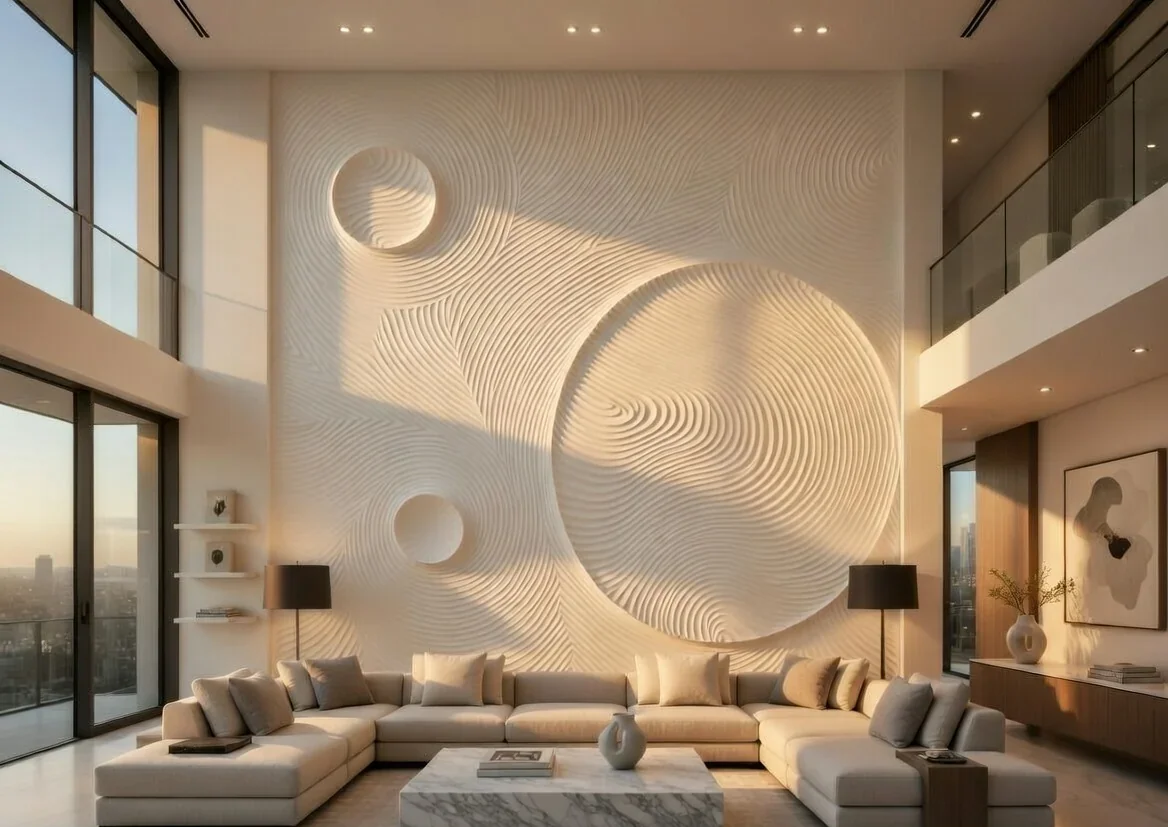
Why the light matters more than the carving on a relief wall - how raking angle, cove placement and finish decide whether a design reads flat or dramatic. Clients spend weeks choosing the design, the stone and the finish for a carved feature wall, then treat lighting as something to sort out after the wall is fitted. That order is backwards. The same carving, lit two different ways, can look like a masterpiece or a flat, grey slab - and by the time the wall is on site, most of the useful options are gone.
Flat light flattens the carving
A relief wall is read almost entirely through shadow, not colour. Point a broad, even light straight at a carved surface - a ceiling downlight, daylight through a window facing the wall - and the shadows that give the design its depth largely disappear. A design that looked dramatic in the render can end up looking oddly flat on site, and it's rarely the carving that's at fault. It's the angle of the light.
Raking light is what makes a relief read
Light that grazes across a surface at a low angle, rather than hitting it head-on, is what actually reveals a carving. It collects along every raised edge and pools in every recess, so a wall carved with long, shallow ridges - a dune pattern, a woven grid, a field of layered petals - reads soft under flat midday light and sharply dramatic once the same wall catches a low, grazing source in the evening. This is a deliberate part of how a design is drawn in the first place, not a happy accident that shows up later.
Plan the cove before the stone is cut
A cove or a recessed linear fitting that grazes the wall at the right angle has to be built into the wall's structure - the depth of the recess, the distance from the stone, the run of the housing - at the same time the carving is designed, not added afterwards by an electrician working from a finished wall. We cover this coordination in more detail in how a carved wall is actually made: the installation stage is where the lighting plan and the stone finally meet, and it works far better when both were planned together from the start.
Depth changes what the light needs to do
A shallow relief needs a tighter grazing angle to catch any shadow at all - a light mounted too far from the surface, or aimed too directly, will simply wash it out. A deeper composition, where the difference between the highest and lowest point can run from a few millimetres to several centimetres across the same panel, tolerates a broader range of angles and can take a stronger source without losing definition. Some designs are also built to be lit from behind rather than across - a recessed disc or a carved channel can be backlit so it glows rather than shadows, which is a different lighting decision entirely and needs to be settled before the recess itself is cut.
Finish decides how much of that light gets used
The same light, on the same carving, behaves differently depending on the finish - we go through this properly in six stone finishes, explained. A honed or bush-hammered surface holds shadow well and stays legible under a fairly wide range of lighting. A polished finish reflects more of the light directly back at the viewer instead of scattering it into shadow, which can wash out a relief's edges unless the fitting is positioned carefully. Neither is wrong - but the finish and the lighting plan need to be chosen with each other in mind, not separately.
Get this settled at the design stage
If a relief wall is in the plan for a lobby, a majlis, a stair wall or a courtyard, the lighting - fixture type, position, angle - belongs in the same conversation as the carving depth and the stone itself, ideally worked through on the 3D render before anything is cut. Send us the space, including where any existing or planned lighting sits, and we'll tell you honestly whether the design as drawn will actually read the way it looks in the picture.
Ready to talk about your project?
Share your drawings or a reference photo and we'll come back with material options and an honest estimate.