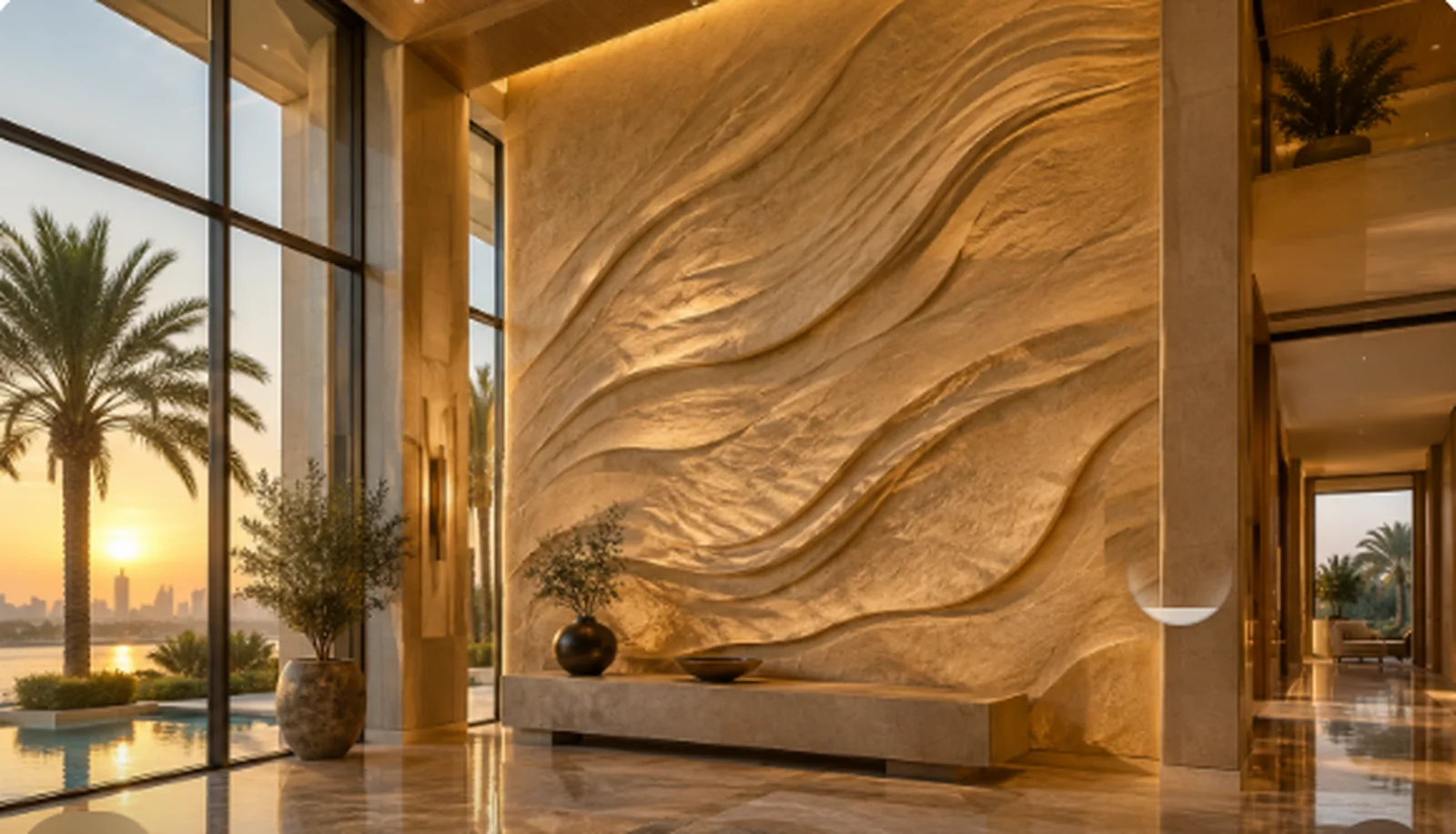
The UAE has no shortage of businesses calling themselves a "stone supplier." Search the term and you'll find importers, resellers, general contractors with a stone division, and genuine workshops - all using similar language, similar renders, similar promises. For an architect, designer or villa owner planning a feature wall, cladding or a bespoke carved piece, that makes the actual decision harder, not easier.
This isn't a ranked list. It's the set of questions worth asking before you commit a project - and your budget - to a supplier.
Start with where the stone actually comes from
Many suppliers in the UAE don't quarry or carve anything themselves - they buy finished or semi-finished stone from a third party and resell it under their own name. That isn't automatically a problem, but it does mean less control over consistency, less flexibility on custom sizes or finishes, and longer, less predictable lead times, since your order is waiting behind someone else's production queue.
Ask directly: is this cut and carved in your own workshop, or sourced from elsewhere? A supplier with their own sourcing and carving operation - even if it's based outside the UAE, as most stone workshops serving the Gulf are - should be able to answer that plainly and tell you which quarry or region the stone comes from.
Check whether the design can actually be customised
A catalogue full of beautiful photographs doesn't tell you whether any of it can be adapted to your specific wall, your specific dimensions, or a stone variety you prefer over what's shown. Some suppliers only sell what's already been produced. Others treat every catalogue design as a starting point that can be resized, recut in a different stone, or reworked in a different finish.
If your project has an unusual dimension, a non-standard wall height, or you want a design carved in a stone other than the one photographed, ask before you assume it's possible. "Made to order" should mean exactly that, not "made to order from a fixed list of sizes."
Find out who actually installs it
Supply and installation are two different skills, and not every supplier does both. Some will happily ship you beautiful stone and leave the fitting to whichever contractor you can find - which works fine if you already have an experienced stone-fixing team, and works badly if you don't. Heavy, textured, hand-carved stone is not the same as fitting standard tiles; incorrect fixing can crack panels, misalign joints, or ruin a carved relief's lighting.
Ask whether the supplier has its own installation team in the UAE, or only supplies. Neither answer is automatically wrong - but you need to know which one you're getting, and budget for installation separately if it isn't included.
A good supplier tells you the truth, even when it costs them the sale
This is the hardest thing to check before you've actually worked with someone, but it's worth asking anyway: will they tell you if a design doesn't suit your space? A heavily textured relief wall in a small, low-lit corridor, or a stone that won't hold up against direct coastal salt air, are the kinds of mismatches an honest supplier flags before production - not after installation, when it's too late to change anything.
"The stone already holds the shape. Our work is only to remove what is not part of it."
Send a site photo or your drawings early and see what comes back: a straight sales pitch, or an honest assessment with an alternative if something else would genuinely work better.
Ask for a render and a sample before anything is cut
For any carved or bespoke piece, a 3D visualisation before production isn't a luxury - it's how you catch a problem while it still costs nothing to fix. The same goes for physical samples of the stone and finish: photographs under studio lighting rarely match how a stone reads in your own space, under your own light.
- A written quotation that specifies stone variety, thickness, finish and total area - not a vague lump sum
- A 3D render for anything carved or custom, revised until you approve it
- A physical sample of the stone and finish, sent before you commit
- A clear lead time, confirmed in writing, not estimated verbally
Match the stone to the Gulf climate
Heat, humidity and salt air behave differently on sandstone, limestone and marble, and a stone that performs beautifully in a temperate climate can discolour, pit or weather badly here within a few years. A supplier who understands UAE conditions should be able to explain, without being asked twice, why they'd recommend one material over another for an exterior cladding job versus an interior feature wall.
Where JJM Stone Art fits into this
We're not going to pretend this guide is neutral - we source and carve our own stone from our workshops in India, every design in our catalogue can be resized or recut to your specification, we run our own installation teams across the UAE, and we'd rather tell you a design won't suit your space than sell it to you anyway. That's the standard this guide describes, because it's the one we hold ourselves to.
Whichever supplier you choose, ask the questions above first. It's the difference between a wall that looks right in a render and one that still looks right in ten years.
Ready to talk about your project?
Share your drawings or a reference photo and we'll come back with material options and an honest estimate.